Written on November 27th, 2014
Aired 08/01/10
RAJ PATEL has worked for the World Bank and WTO and been tear-gassed on four continents protesting against them. Writer, activist, and academic, he is currently a visiting scholar at UC Berkeley's Center for African Studies, a researcher at the School of Development Studies at the University of KwaZulu-Natal, and a fellow at The Institute for Food and Development Policy, also known as Food First. He is the author of STUFFED AND STARVED and his latest THE VALUE OF NOTHING: HOW TO RESHAPE MARKET SOCIETY AND REDEFINE DEMOCRACY.
http://rajpatel.org/
Written on November 18th, 2014
Aired 11/14/10
Spiritual, but Not Religious PHIL GOLDBERG author, AMERICAN VEDA: From Emerson and the Beatles to Yoga and Meditation -- How Indian Spirituality Changed the West
GREG EPSTEIN Humanist Chaplain, Harvard University and author, GOOD WITHOUT GOD: What a Billion Nonreligious Do Believe
Learn more at philipgoldberg.com and AmericanVeda.com
Learn more at harvardhumanist.org
Written on November 12th, 2014
Aired 04/11/10
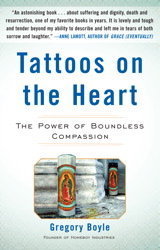
Father Boyle has made a point of collecting and telling uniquely powerful stories of life and death, and his work has supplied him with more than anyone should know.He has so far buried 168 of his homies, and fills his first book TATTOOS ON THE HEART with their stories. I read it cover to cover on a plane flight Chicago to LA, and cried at least a dozen times. Boyle's compassion is boundless, his work is courageous, and his example is a profound challenge.
Father GREGORY BOYLE was ordained a Jesuit priest in 1982. He received his Master of Divinity from the Weston School of Theology; and a Sacred Theology Masters degree from the Jesuit School of Theology. Since 1986, Father Gregory has been the pastor of Dolores Mission in the Boyle Heights neighborhood of Los Angeles. The church sits between two large public housing projects, Pico Gardens and Aliso Village, known for decades as the gang capital of the world. In 1988, Father Boyle began what would become Homeboy Industries, now located in downtown Los Angeles. His first book is TATTOOS ON THE HEART.
http://www.homeboy-industries.org/
Written on November 5th, 2014
Aired 08/01/09
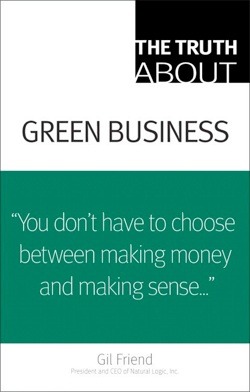
"You don't have to choose between making money and making sense.... Green business practices are good for business and for the world. They can increase profits, lower costs, and attract customers."
Those are the words of Gil Friend. Gil and I met in 1973 when I directed a video documentary of a Buckminster Fuller World Game Workshop. Each in our own ways, we've been plugging away at that game ever since.
Gil Friend, President & CEO of Natural Logic Inc, is a systems ecologist and business strategist with nearly 40 years experience in communications, business, and environmental innovation. Clients include Agilent Technologies, Coca-Cola, Dean Foods, Hewlett Packard, Levi Straus & Co, Nike and Sun MicroSystems. Friend is the author of the upcoming Risk, Fiduciary Responsibility and the Laws of Nature, and just published, The Truth About Green Business.
http://www.worldchanging.com/
Written on October 31st, 2014
Aired: 02/03/13
This week, my guest is DAVID GOLDHILL. After the death of his father, Goldhill, a business executive, began a personal exploration of a health-care industry that for years has delivered poor service and irregular quality at astonishingly high cost.
His September 2009 Atlantic cover story rocked the health-care world, and Goldhill has written a book expanding on the topic, Catastrophic Care: How American Health Care Killed My Father-And How We Can Fix It. It is a system, he argues, that is not worth preserving in anything like its current form. He asserts Obamacare will not fix it, and offers his own radical solution.
* As a nation, we now spend almost 18% of our GDP on health care.
* In 1966, Medicare and Medicaid made up 1% of total government spending; now that figure is 20%.
* The federal government spends
– 8 times as much on health care as it does on education
— 12 times what it spends on food aid to children and families
— 30 times what it spends on law enforcement
— 78 times what it spends on land management and conservation
— 87 times the spending on water supply
— 830 times the spending on energy conservation.
* For every two doctors in the U.S., there is now one health-insurance employee-more than 470,000 in total. In 2006, it cost almost $500 per person just to administer health insurance.