Q&A: Chris Mooney – The Republican Brain
Written on October 22nd, 2014 |
Aired 05/16/12
Crazy though it may be, I assume many have accepted the fact that the Republican party has a problem with science and ultimately with evidence facts — reality. It is now a matter of politics for them to deny science. Among their presidential primary candidates, only Jon Huntsman and Mitt Romney accept that warming is happening and humans are a contributing factor.
CHRIS MOONEY has been on this trail for years. In 2005, he wrote the best-selling
THE REPUBLICAN WAR ON SCIENCE. By the time their anti-science, anti-reality bias was established, MOONEY was asking a deeper question. Did science have anything to teach us about why? And it turns out, recently, science does. That brings us to Chris’s new book, The Republican Brain: The Science of Why They Deny Science and Reality.
According to Mooney, from climate change to evolution, the rejection of mainstream science among Republicans is growing. Not only that, so is denial of expert consensus on the economy, American history, foreign policy, and much more. Why won’t Republicans accept things that most experts agree on? Why do they fight facts? He writes that the political parties reflect personality traits and psychological needs -Republicans wedded to certainty, Democrats to novelty – and this is the root of our divide over reality.
Hopefully, understanding how or why Republicans deny science and facts should suggest ways to interact and work with that “reality” differently in order to be more effective moving forward.
http://scienceprogressaction.org
Free Forum Q&A : JANE McGONIGAL, REALITY IS BROKEN – How Gamers Can Change the World
Written on October 17th, 2014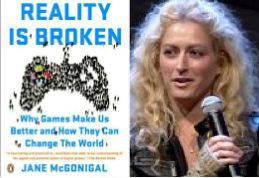 |
In her There are 183 million active video gamers in the US, and the average young person will spend 10,000 hours gaming by the age of 21. There are now more than five million “extreme” gamers” in the US who play an average of 45 hours a week.
According to game designer JANE McGONIGAL, this is because videogames are increasingly fulfilling genuine human needs. But she goes way beyond that, in her first book, REALITY IS BROKEN– just out in paperback – she suggests we can use the lessons of game design to fix what is wrong with the real world.
Drawing on positive psychology, cognitive science, and sociology, she shows how game designers have hit on core truths about what makes us happy so that videogames consistently provide the exhilarating rewards, stimulating challenges, and epic victories that are so often lacking in the real world.
I recommend REALITY IS BROKEN to people who have no interest in games. Separate from what it says about the current reality and possible future of games, the book is an excellent primer on what we have learned – and most people don’t know – about happiness, learning, productivity and growth.
Q&A: DAVID KIRP, Author – Kids First
Written on October 8th, 2014 |
Q&A: Frances Moore Lappé, Author – ECOMIND: CHANGING THE WAY WE THINK, TO CREATE THE WORLD WE WANT
Written on October 2nd, 2014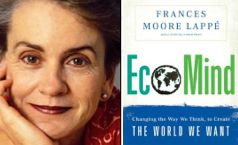 |
Aired: 9/8/13
Originally Aired: 12/30/12
Where do you think the most important changes need to take place to turn things around in terms of big issues like the economy, the environment, and social justice?
Some might say climate change is the critical global issue so it must be clean energy. Others might say nothing will make as much difference for the world’s people as educating and empowering girls and women. Closer to home, a case can be made that public financing of political campaigns would have the most impact on all such issues by making it possible for the power of the United States to become a greater force for good.
All good answers, but this week’s guest gives another answer – and its one that I share. Frances Moore Lappe, who has herself been a force for good at least since the publication of the phenomenal best-seller Diet for a Small Planet in 1971, says that the greatest impact would follow from changing our minds.
In her 18th book, ECOMIND: CHANGING THE WAY WE THINK, TO CREATE THE WORLD WE WANT, Lappé argues that much of what is wrong with the world, from eroding soil to eroding democracies, results from ways of thinking that are out of sync with human nature and nature’s rhythms. Humans are doers, she says. But our capacity for doing is undermined by seven “thought traps” that leave us mired in fear, guilt, and despair — none of which are motivators to action.
Drawing on the latest research in climate studies, anthropology, and neuroscience, she weaves her analysis together with stories of real people the world over, who, having shifted some basic thought patterns, now shift the balance of power in our world. Chapter-by-chapter, Lappé takes us from “thought trap” to “thought leap,” and with each shift, challenges become opportunities.
Q&A: PAUL GILDING – Author, THE GREAT DISRUPTION
Written on October 2nd, 2014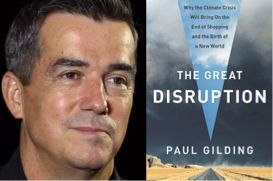 |
Aired 06/10/12
PAUL GILDING says it’s time to stop worrying about climate change. We need instead to brace for impact because global crisis is no longer avoidable. He believes this Great Disruption started in 2008, with spiking food and oil prices and melting ice caps. It is not simply about fossil fuels and carbon footprints. We have come to the end of Economic Growth, Version 1.0, a world economy based on consumption and waste, where we lived beyond the means of our planet’s ecosystems and resources
According to Gilding, the coming decades will see loss, suffering, and conflict as our planetary overdraft is paid; however, they will also bring out the best humanity can offer: compassion, innovation, resilience, and adaptability.
Gilding says we must fight-and win-what he calls The One Degree War to prevent catastrophic warming of the earth. He believes the crisis offers us a chance to replace our addiction to growth with an ethic of sustainability, and an unmatched business opportunity as old industries collapse and new companies reshape our economy. In the aftermath of the Great Disruption, we will measure “growth” not by quantity of stuff but quality of life.
PAUL GILDING is an independent writer, advisor and advocate for action on climate change and sustainability. He has been involved with and led activist campaigns on a wide variety of social and environmental issues and served as Executive Director, Greenpeace Australia and Greenpeace International. Gilding founded Ecos Corporation in 1995, consulting to some of the world’s largest corporations on issues of sustainability until its sale in 2008. His first book is THE GREAT DISRUPTION: Why the Climate Crisis will Bring on the End of Shopping and the Birth of a New World.


