
Free Forum Q&A – TIM RYAN Congressman, author, A MINDFUL NATION: How a Simple Practice Can Help Us Reduce Stress, Improve Performance, Recapture American Spirit & WINIFRED GALLAGHER RAPT: Attention and the Focused Life
Written on April 2nd, 2015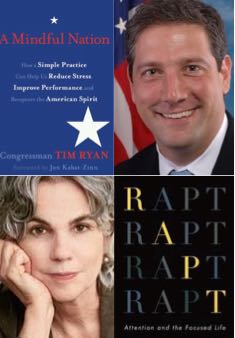
TIM RYAN (originally aired August 2012)
WINIFRED GALLAGHER (originally aired May 2009)
“My experience is what I agree to attend to.” — William James
This week we focus on mindful attention – hailed by ancient spiritual traditions and modern neuroscience alike as one of the keys to the quality of our lives.
In the first half, I’ll be joined by Ohio Congressman TIM RYAN, who offers a radical solution to the stresses and problems that face Americans today — radical in its original meaning of having to do with roots of things. He has written a book, A MINDFUL NATION: How a Simple Practice Can Help Us Reduce Stress, Improve Performance, and Recapture the American Spirit. Ryan has a daily practice of mindful meditation and now he’s advocating that the spread of similar practices could help heal us, not just as individuals but as a nation. And his book is filled with examples of how mindfulness is already being successfully applied in education, healthcare, even the military.
Then I’ll speak with bestselling author, WINIFRED GALLAGHER about her book, RAPT: Attention and the Focused Life. In it, she argues that “”The skillful management of attention is the… key to improving virtually every aspect of your experience, from mood to productivity to relationships.” Gallagher came to appreciate this while fighting a fairly advanced form of cancer. Determined not to let her illness “monopolize” her attention, she made a conscious choice to look “toward whatever seemed meaningful, productive, or energizing and away from the destructive, or dispiriting.” Her experience of the world was transformed, and she set out to learn more about the science of attention as well as what we can do to cultivate it.
Here’s one big tip based on neuroscience: GALLAGHER recommends starting your workday concentrating on your most important task for 90 minutes. At that point, your brain may need a break But don’t let yourself get distracted by anything else during that first hour and a half, because it can take the brain 20 minutes to reboot after an interruption.
Free Forum Q&A – GEORGE McGOVERN A Politician of Principle & ANDREW BACEVICH THE LIMITS OF POWER: The End of American Exceptionalism
Written on March 27th, 2015
GEORGE McGOVERN (originally aired November 2005)
ANDREW BACEVICH (0riginally aired September 2008)
As Congress debates a new budget this week, I read the following headline, “Defense hawks in U.S. Congress move to boost military budgets.” It’s worth noting that the US spends more on “defense” than the next 9 countries combined. So this week I offer you interviews with two men whose military service contributed to their cautious view of America’s armed adventures – longtime Senator and 1972 Democratic presidential candidate, George McGovern and retired Army colonel Andrew Bacevich, who is now the first George McGovern Fellow at Columbia University.
At 24, I ran an Assembly District in LA County for McGovern’s Presidential campaign. In 2005, with the release of the documentary, One Bright Shining Moment: The Forgotten Summer of George McGovern, I had the opportunity to record this interview.
in The Limits of Power, I believe Andrew Basevich pulls things together in ways that I hadn’t seen before. Things like our politics of personality, the rise of the imperial presidency, and our national culture of consumption and how all of those link to our military adventures. I say each week that I’m looking for pieces of the puzzle, and I believe today’s guest is pulling some of them together in ways that make our problems clearer and change more possible.
Free Forum Q&A – GANGA WHITE, YOGA BEYOOND BELIEF: Insights to Awaken and Deepen Your Practice & STEVEN PINKER, THE STUFF OF THOUGHT: Language as a Window into Human Nature
Written on March 20th, 2015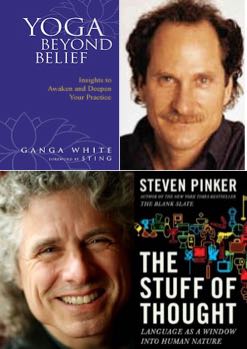
Ganga White (originally aired: July 2007)
Steven Pinker (originally aired: October 2007)
I’ve been practicing yoga since 1970, obviously long before it was a major cultural phenomenon. GANGA WHITE started a few years earlier. YOGA BEYOND BELIEF: Insights to Awaken and Deepen Your Practice speaks to the way I’ve thought about yoga. It’s about paying attention, lifelong learning, and discovering our own paths to growth, integration and presence. It talks about living life as a meditation – but not in the navel-gazing or guru-following way many may think about meditation. It also takes issue with many in the yoga world today who tend to make it a rigid strictly codified authoritarian practice. Why does the FCC get so riled up about salty language? How do lobbyists bribe politicians? Why do romantic comedies get such mileage out of the ambiguities of dating? And why is bulk email called spam? These are some of the everyday questions STEVEN PINKER tackles in THE STUFF OF THOUGHT: Language as a Window into Human Nature. We know language helps us communicate, but what can words tell us about ourselves? Harvard professor and two-time Pulitzer Prize finalist, PINKER explores how language illuminates the mind.
Q&A w/ Author, GEORGE PACKER – THE UNWINDING: Inner History of New America
Written on February 5th, 2015Aired: 06/09/13
 |
NYTimes review: “This book hums – with sorrow, outrage and compassion.”- #8 Best-seller
Free Forum Q&A : JANE McGONIGAL, REALITY IS BROKEN – How Gamers Can Change the World
Written on October 17th, 2014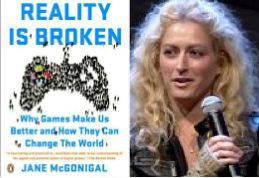 |
In her There are 183 million active video gamers in the US, and the average young person will spend 10,000 hours gaming by the age of 21. There are now more than five million “extreme” gamers” in the US who play an average of 45 hours a week.
According to game designer JANE McGONIGAL, this is because videogames are increasingly fulfilling genuine human needs. But she goes way beyond that, in her first book, REALITY IS BROKEN– just out in paperback – she suggests we can use the lessons of game design to fix what is wrong with the real world.
Drawing on positive psychology, cognitive science, and sociology, she shows how game designers have hit on core truths about what makes us happy so that videogames consistently provide the exhilarating rewards, stimulating challenges, and epic victories that are so often lacking in the real world.
I recommend REALITY IS BROKEN to people who have no interest in games. Separate from what it says about the current reality and possible future of games, the book is an excellent primer on what we have learned – and most people don’t know – about happiness, learning, productivity and growth.


