
Free Forum Q&A: SARA DAVIDSON, author of THE DECEMBER PROJECT: An Extraordinary Rabbi and a Skeptical Seeker Take Aim at Our Greatest Mystery
Written on July 18th, 2014 |
Aired: 03/16/14
We all deal day to day with a lot of questions and a lot of fears – around work, money, health, politcs, relationships. And at some point, we will all deal with the final fears and the final questions – fear of death and questions about what it means and what if anything comes after.
At his request, today’s guest, SARA DAVIDSON met every Friday for two years with 89-year-old RABBI ZALMAN SHACHTER-SHALOMI, the iconic founder of the Jewish Renewal movment, to discuss what he calls THE DECEMBER PROJECT. “When you can feel in your cells that you’re coming to the end of your tour of duty,” in tHe rabbi’s words, “what is the spiritual work of this time, how do we prepare for the mystery?”
Davidson, who describes herself as having a seeker’s heart and a skeptic’s mind, feared death would be a complete annihilation, while Reb Zalman felt certain that “something continues.” He didn’t want to convince her of anything, but to loosen her mind.” Through their talks, he wanted to help people “not freak out about dying,” and enable them to have a more heightened and grateful life.
Free Forum Q&A – TOM SHADYAC, director of documentary: I AM ; author of LIFE’S OPERATING MANUAL
Written on July 4th, 2014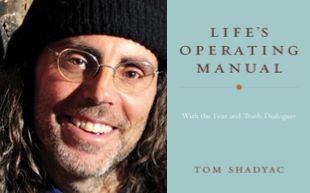 |
Aired: 07/28/13
I sometimes say that in a past life I worked in the entertainment industry, comedy in particular. I co-wrote and co-produced novelty records THE HOMECOMING QUEEN’S GOT A GUN, I LIKE EM BIG AND STUPID and EARTH GIRLS ARE EASY all performed by Julie Brown. I directed comic music videos for some of these songs, and ended up co-writing and co-producing the film EARTH GIRLS ARE EASY. I’ve produced and hosted this show since 1996 and I consult and speak primarily to non-profits and foundations, working with them on communications, encouraging them to tell better stories.
My transition seems mild compared with that of this week’s guest, TOM SHADYAC, whose phenomenally successful writing/directing/producing career included the hits- ACE VENTURA: PET DETECTIVE, LIAR LIAR, THE NUTTY PROFESSOR, BRUCE ALMIGHTY, and PATCH ADAMS . His films grossed nearly $2 billion and earned him four People’s Choice awards and a ton of money.
His 2011 documentary, I AM recounts what happened after a cycling accident left him incapacitated for months. Though he ultimately recovered, he emerged a changed man. In the film, Shadyac meets with a variety of thinkers and doers including David Suzuki, Noam Chomsky, Howard Zinn, and Archbishop Desmond Tutu – asking what’s wrong with society and what can we do make things better?
Tom’s now written a book, LIFE’S OPERATING MANUAL, which asks whether life comes with a set of guidelines? If so, what are they? And finally, do we have the courage to pay attention and to change? Rather than spoil the plot by telling you his answers, join us for the conversation.
Free Forum Q&A – TIM DECHRISTOPHER: Civil disobedience (bidding) at public lands auction landed him 21 months in prison
Written on May 25th, 2014 |
Aired: 6/30/13
On December 19, 2008 TIM DeCHRISTOPHER disrupted a highly disputed BLM auction, effectively safeguarding thousands of acres of land. Not content to merely protest outside, Tim entered the auction hall and registered as bidder #70. He outbid industry giants on land parcels (which, starting at $2 an acre, were adjacent to national treasures like Canyonlands National Park), winning 22,000 acres of land worth $1.7 million Two months later, incoming Interior Secretary Ken Salazar invalidated the auction. Yet DeChristopher was indicted and tried on two federal felonies and spent 21 months in prison.
Released in April 2013, DeChristopher is the subject of documentary film, Bidder 70, which opened this weekend at the Music Hall in Beverly Hills and other theaters around the country. He joins me this week to tell his story. What led him to that auction? What went through his mind as he began bidding and winning? Why didn’t he take a plea deal? What was his experience in prison? What message does he have for others?
We’ll also talk about the state of the movements to deal with energy, environment, and climate change, in light of Obama’s recent speech and the eventual decision whether or not to build the KeystoneXL pipeline.
“At this point of unimaginable threats on the horizon, this is what hope looks like. In these times of a morally bankrupt government that has sold out its principles, this is what patriotism looks like. With countless lives on the line, this is what love looks like, and it will only grow…
— From Tim DeChristopher’s statement to the court at his sentencing hearing
FREE FORUM Q&A: CHUCK COLLINS – Author, “99 to 1″
Written on April 16th, 2014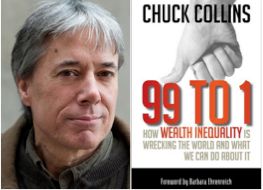 |
Aired 04/15/12
For over thirty years, you and I have lived through a radical redistribution of wealth — upward, to a tiny fraction of the population — as though we’re part of a bizarre experiment to see how much inequality a democratic society can tolerate. Finally this past year, as a result of the Great Recession that burst the mortgage/refi/credit card bubble that had allowed too many of us to deny reality, people have woken up and “We are the 99%,” the rallying cry of the Occupy movement, has spread far and wide.
CHUCK COLLINS has been on the case since at least 1995, when he co-founded United for a Fair Economy to raise the profile of the inequality issue and support efforts to address it. In fact, when he did so, he was one of my first guests on this show and we talked then about the same issues we will talk about today.
Chuck’s new book, 99 to 1: How Wealth Inequality is Wrecking the World and What We Can Do About It, paints a picture of how disparities in wealth and power play out in America and the world, and identifies the shifts in social values, political power, and economic policy that have led to our current era of extreme inequality. He lays out the destructive cost of inequality on virtually every aspect of society.
But Collins believes there’s hope and offers proposals for closing the gap, and a guide to many of the groups working toward a society that works for everybody.
FREE FORUM Q&A: JANINE BENYUS, Natural Sciences Writer – Biomimicry
Written on April 16th, 2014 |
Aired 06/12/11
JANINE BENYUS is a natural sciences writer, innovation consultant, and author of six books, including Biomimicry: Innovation Inspired by Nature. Since the book’s 1997 release, Janine has evolved the practice of biomimicry, consulting with sustainable business, academic, and government leaders. Janine has co-founded the Biomimicry Guild, the Biomimicry Institute, and the web portal http://www.asknature.org/ to further this work. Her next book will be Nature’s Code
http://www.biomimicryinstitute.org


