Q&A w/ CHRISTOPHER RYAN, author (co-author, Cacilda Jethá) – SEX AT DAWN: How We Mate, Why We Stray, and What It Means for Modern Relationships
Written on June 4th, 2014 |
Aired: 04/28/13
In the best-selling book, SEX AT DAWN, CHRISTOPHER RYAN and co-author Cacilda Jethá aim to answer the question, “What is the essence of human sexuality and how did it get to be that way?” They contend that, “Cultural shifts that began about ten thousand years ago rendered the true story of human sexuality so subversive and threatening that for centuries it has been silenced by religious authorities, pathologized by physicians, studiously ignored by scientists, and covered up by moralizing therapists.”
What is that true story? According to Ryan and Jetha, first, “We didn’t descend from apes. We are apes.” They liken us most to bonobos. Further, “human beings evolved in intimate groups where almost everything was shared – food, shelter, protection, child care, even sexual pleasure.”
Needless to say, their attempt to overturn the accepted narrative on such a hot topic as sex has led to controversy. RYAN joins me this week to explore these questions.
Chris Ryan Podcast Link:
http://bit.ly/ZZqtKy
Q&A: CHARLES DUHIGG – THE POWER OF HABIT
Written on May 16th, 2014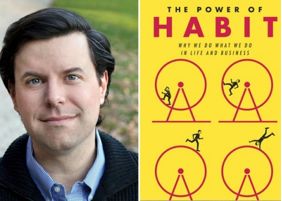 |
Aired 08/26/12
Humans are not alone in being creatures of habit, but can we do anything about it?
Brain science has learned a lot about habits over the last few years. On the one hand, that gives corporations new power with which to manipulate us, but it also gives us greater power over our own behavior.
What is a habit? Are habits positive – a sign of cultivation and industry, or negative, a sign of weakness and mindlessness? Or are they neutral, their value up to us?
Today’s guest, CHARLES DUHIGG an award-winning reporter for the New York Times, has written the best-selling THE POWER OF HABIT: Why We Do What We Do in Life and Business. He tells us that at its most basic level, a habit is a simple neurological loop: a cue (my mouth feels gross), a routine (I should brush my teeth), and a reward (ahhh, minty fresh!). Backing out of the driveway, replying to emails, running before work – many of our most basic daily actions are not, in fact, the products of well considered decision-making, but outgrowths of habits we often don’t even realize exist.
We’ll talk about what a habit is, how they are formed, and how we can put what we’ve learned about habits into practice, so that we are at least somewhat their masters rather than their slaves.
We will also discuss Duhigg’s investigative New York Times series on Apple, including their labor practices and why they don’t manufacture in the U.S.
Q&A: RICHARD WILKINSON & KATE PICKETT, Authors – The Spirit Level: Why More Equal Societies Almost Always Do Better
Written on March 2nd, 2014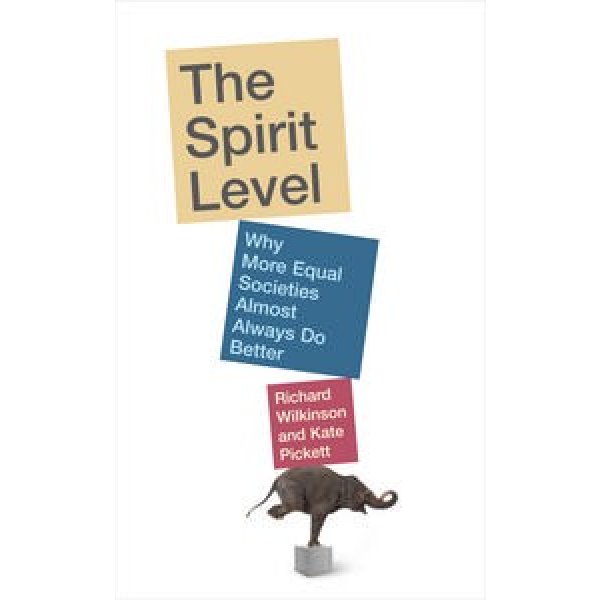 |
Originally Aired: 01/31/10
RICHARD WILKINSON & KATE PICKETT authors of an important new book: The Spirit Level: Why More Equal Societies Almost Always Do Better
In the UK, the Guardian says The Spirit Level “might be the most important book of the year, and The New Statesman named it one of the top ten books of the past decade.
Based on thirty years’ research, The Spirit Level shows that unequal societies are bad for the well-off as well as the poor, when it comes to health and social problems, child well being, life expectancy, infant mortality, obesity, educational scores, drop out rates, illegal drug use, mental illness, homicide, incarceration, CO2 emissions, recycling, social mobility, innovation, and levels of trust.
The good news: If all these ills are related to one measure – income inequality, then, decreasing inequality should be the central goal of our politics because we can be confident that it works.
RICHARD WILKINSON has played a leading role in international research on inequality. He studied economic history at the London School of Economics before training in epidemiology, and is Professor Emeritus at the University of Nottingham Medical School and Honorary Professor at University College London.
KATE PICKETT is a senior lecturer at the University of York and a National Institute for Health Research Career Scientist. She studied physical anthropology at Cambridge, nutritional sciences at Cornell and epidemiology at Berkeley before spending four years as an Assistant Professor at the University of Chicago.
Free Forum Q&A: TERRENCE McNALLY Turning the tables, my turn to answer Qs interviewed by Sara Davidson
Written on February 4th, 2014 |
Aired: 2/2/14
I am going to take a hiatus from this show in a few weeks, for the first time in 17 years. I need to focus on some other projects, including a book I’m writing, and won’t be able to afford the time to produce and host this show probono.
In anticipation of this upcoming break, I will be the guest this week and SARA DAVIDSON, best-selling author of Loose Change and Leap, whose new book, The December Project will come out in March, will be interviewing me. I’ve long thought it is only fair that I have to answer a few questions and this week it’s going to happen.
Free Forum Q&A- HAZEL HENDERSON, Ethical Markets Can We Still Solve Big Problems?-Part2
Written on January 29th, 2014 |
Aired: 1/26/14
As we begin a new year, let’s look at where we are in the big picture. What are the most critical issues facing the US and the world? How do you see things moving in those areas? How are things getting worse or better? What should we be keeping our eyes on in the year to come?
My guest this week will be HAZEL HENDERSON, who’s been asking these sorts of questions for at least the last 40 years. We’re going to approach this exploration globally as well as nationally, with a long-term view, and with an eye toward relationships and systems that we often miss in our day-to-day focus on the latest news and events.
If this sounds familiar, it’s because this was my plan a few weeks ago when Hazel was my guest. But we ended up spending so much time on her journey – a remarkable journey it is, a mom in New York who’d never been to college got upset about pollution threatening her young child, became an activist, and developed into a global expert on economics and sustainability.


