Free Forum Q&A : JANE McGONIGAL, REALITY IS BROKEN – How Gamers Can Change the World
Written on October 17th, 2014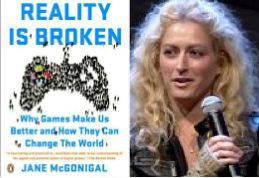 |
In her There are 183 million active video gamers in the US, and the average young person will spend 10,000 hours gaming by the age of 21. There are now more than five million “extreme” gamers” in the US who play an average of 45 hours a week.
According to game designer JANE McGONIGAL, this is because videogames are increasingly fulfilling genuine human needs. But she goes way beyond that, in her first book, REALITY IS BROKEN– just out in paperback – she suggests we can use the lessons of game design to fix what is wrong with the real world.
Drawing on positive psychology, cognitive science, and sociology, she shows how game designers have hit on core truths about what makes us happy so that videogames consistently provide the exhilarating rewards, stimulating challenges, and epic victories that are so often lacking in the real world.
I recommend REALITY IS BROKEN to people who have no interest in games. Separate from what it says about the current reality and possible future of games, the book is an excellent primer on what we have learned – and most people don’t know – about happiness, learning, productivity and growth.
Q&A: DAVID KIRP, Author – Kids First
Written on October 8th, 2014 |
Q&A: Frances Moore Lappé, Author – ECOMIND: CHANGING THE WAY WE THINK, TO CREATE THE WORLD WE WANT
Written on October 2nd, 2014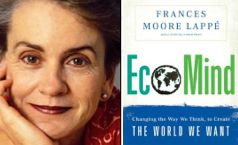 |
Aired: 9/8/13
Originally Aired: 12/30/12
Where do you think the most important changes need to take place to turn things around in terms of big issues like the economy, the environment, and social justice?
Some might say climate change is the critical global issue so it must be clean energy. Others might say nothing will make as much difference for the world’s people as educating and empowering girls and women. Closer to home, a case can be made that public financing of political campaigns would have the most impact on all such issues by making it possible for the power of the United States to become a greater force for good.
All good answers, but this week’s guest gives another answer – and its one that I share. Frances Moore Lappe, who has herself been a force for good at least since the publication of the phenomenal best-seller Diet for a Small Planet in 1971, says that the greatest impact would follow from changing our minds.
In her 18th book, ECOMIND: CHANGING THE WAY WE THINK, TO CREATE THE WORLD WE WANT, Lappé argues that much of what is wrong with the world, from eroding soil to eroding democracies, results from ways of thinking that are out of sync with human nature and nature’s rhythms. Humans are doers, she says. But our capacity for doing is undermined by seven “thought traps” that leave us mired in fear, guilt, and despair — none of which are motivators to action.
Drawing on the latest research in climate studies, anthropology, and neuroscience, she weaves her analysis together with stories of real people the world over, who, having shifted some basic thought patterns, now shift the balance of power in our world. Chapter-by-chapter, Lappé takes us from “thought trap” to “thought leap,” and with each shift, challenges become opportunities.
Q&A: DAN PALLOTTA, CHARITY CASE: How the Non-Profit Community Can Stand Up for Itself and Really Change the World
Written on August 15th, 2014 |
Aired: 04/15/13
When someone approaches you to donate to a non-profit, how many of you want to know how much of of its money goes to salaries and fund-raising and how much goes to actual program services? If you’re like most people, that question probably figures into your decision.
I myself have factored that question of how much is spent on overhead into my charitable giving. But is it a valid or wise way to make such decisions? According to today’s guest, DAN PALLOTTA, while it may be helpful, much more important is how well they serve their mission, how good a job they’re doing solving the problems you care about.
In his earlier book, UNCHARITABLE, Pallotta, who has a record of helping to raise hundreds of millions of dollars for causes, made the case that the way we think about non-profits and the rules we set for them, makes it harder for them to succeed on a truly significant scale. Too many nonprofits, he says, are rewarded for how little they spend — not for what they get done. Instead of equating frugality with morality, he asks us to start rewarding charities for big goals and big accomplishments (even if that comes with big expenses). Where other folks suggest ways to optimize performance inside the existing paradigm, UNCHARITABLE suggests that the paradigm itself is the problem and calls into question our fundamental beliefs about charity.
With a new book, CHARITY CASE: How the Non-Profit community Can Stand Up for Itself and Really Change the World and in a recent very popular TED talk, he says “My goal … is to fundamentally transform the way the public thinks about charity within 10 years.”
www.danpallotta.com
www.advertisingforhumanity.com
Q&A: SHERRY TURKLE, Psychologist & Author – ALONE TOGETHER
Written on August 6th, 2014 |
Aired 02/13/11
How much technology do you use? Email, texting, facebook, twitter, second life, etc. How's it working for you? Has it freed you up, given you more time, or has it added new demands to your life that actually make you feel you have less time? If you're using social media regularly, do you feel more connected with your friends and family or less?
Clinical psychologist SHERRY TURKLE has been studying our relationship with technology for most of her career, and has written several books about what she's experienced and learned. Of her newest, ALONE TOGETHER, she has said, "This is a book of repentance. I have been studying computers and people for thirty years. I didn't see several important things. I got some important things wrong." I was already interested in talking to her, but that really grabbed my attention. I'm interested in people, maybe especially experts, who are willing to change their minds.
Turkle writes: "Technology promises to let us do anything from anywhere with anyone. But it also drains us as we try to do everything everywhere. We begin to feel overwhelmed and depleted by the lives technology makes possible. We may be free to work from anywhere, but we are also prone to being lonely everywhere. In a surprising twist, relentless connection leads to a new solitude. We turn to new technology to fill the void,but as technology ramps up, our emotional lives ramp down."
http://www.alonetogetherbook.com/


