
Q&A: AQEELA SHERRILLS – Community Self-Determination Institute
Written on April 25th, 2012 |
Aired 04/22/12
AQEELA SHERRILLS
20 years ago this spring there was a riot/disturbance following the Rodney King verdict. But there was another event in 1992 that received somewhat less attention, but was more remarkable: The Peace Treaty between the Crips and Bloods. Aqeela Sherrills was intimately involved in negotiating that treaty and is spearheading a celebration/reunion next week on its 20th anniversary. He is executive director and co-founder (with his brother Daude) of the Community Self-Determination Institute. He also co-founded Amer-I-Can with American football player Jim Brown. Sherrills’ son, Terrell Sherrills, was shot to death in 2004 in an apparently random killing. A longtime anti-death penalty activist, Sherrills became the Southern California Outreach Coordinator for California Crime Victims for Alternatives to the Death Penalty (CCV) in 2010.
EVENT:
Los Angeles “Peace Treaty” 20th Anniversary Reunion Celebration.
Community Dialogue this Friday April 27th all day at the Maxine Waters Employment Preparedness Cener, 10925 S Central Av.LA 90059. It will include Jim Brown, Connie Rice, Alex Sanchez, Rick Ross, among others.
UNITY MUSIC celebration — all day Saturday April 28th — Graham Ave and 103rd –featuring the Watts Prophets, Charles Wright and the 103rd Street Band and many others. To learn more go to https://www.facebook.com/20thPeaceTruce#!/20thPeaceTruce
Q&A: CHUCK COLLINS – Author, “99 to 1”
Written on April 17th, 2012 |
Aired 04/15/12
For over thirty years, you and I have lived through a radical redistribution of wealth — upward, to a tiny fraction of the population — as though we’re part of a bizarre experiment to see how much inequality a democratic society can tolerate. Finally this past year, as a result of the Great Recession that burst the mortgage/refi/credit card bubble that had allowed too many of us to deny reality, people have woken up and “We are the 99%,” the rallying cry of the Occupy movement, has spread far and wide.
CHUCK COLLINS has been on the case since at least 1995, when he co-founded United for a Fair Economy to raise the profile of the inequality issue and support efforts to address it. In fact, when he did so, he was one of my first guests on this show and we talked then about the same issues we will talk about today.
Chuck’s new book, 99 to 1: How Wealth Inequality is Wrecking the World and What We Can Do About It, paints a picture of how disparities in wealth and power play out in America and the world, and identifies the shifts in social values, political power, and economic policy that have led to our current era of extreme inequality. He lays out the destructive cost of inequality on virtually every aspect of society.
But Collins believes there’s hope and offers proposals for closing the gap, and a guide to many of the groups working toward a society that works for everybody.
Q&A: JONAH LEHRER, Author, NYT #1 Best-Seller – IMAGINE: How Creativity Works
Written on April 11th, 2012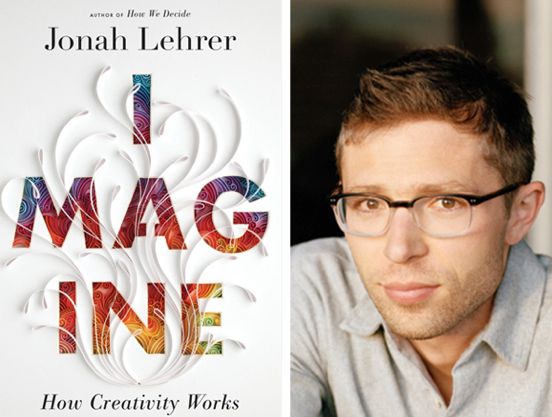 |
Aired 04/08/12
Do you consider yourself to be creative? Do you think of creativity as a gift, a talent, something you either have or you don’t? Do you find creativity to be a bit mystical or magical, dependent on luck, the muses, or higher powers?
Today’s guest, JONAH LEHRER, has written a book in which he looks at the latest brain science and attempts, in his words, “to collapse the layers of description separating the nerve cell from the finished symphony, the cortical circuit from the successful product.”
In Imagine: How Creativity Works, Lehrer makes clear, “Creativity shouldn’t seem like something otherworldly. It shouldn’t seem like a process reserved for artists or inventors or other “creative types.” After all, he points out, the human mind has the creative impulse built into its operating system, hard-wired into its most essential programming code.” Creativity is a variety of distinct thought processes that we can all learn to use more effectively. In the book, Lehrer reveals the importance of embracing the rut, thinking like a child, and daydreaming productively. He also shows how we can use this knowledge to make our neighborhoods more vibrant, our companies more productive, and our schools more effective.
Q&A: Connie Rice – author, Power Concedes Nothing
Written on April 3rd, 2012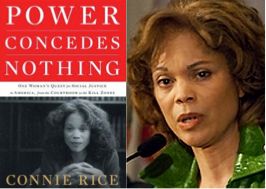 |
Aired 04/01/12
Too often problems are not solved, solutions are not found or implemented, and money, lives and moments of opportunity are wasted.
CONNIE RICE has taken on school and bus systems, Death Row, the states of Mississippi and California, and the LAPD – and won. Not just in court but also on the streets and in prisons, where she has spearheaded campaigns to reduce gang violence. She has long been dedicated, in her words, to finishing what Martin Luther King Jr started, and she pursues that aim with a focused passion, intelligence, and commitment.
Too often we oppose each other rather than looking for every opportunity to align to solve a problem. Rice sues a model of law enforcement that dominated Los Angeles for decades. In response, the model begins to shift. She then works with — and finally — within LA Law Enforcement. The model shifts some more. Such movement calls for the right sequence of opposition and cooperation, the strategic use of the tools available, and the ability of both sides to shift from litigation to collaboration.
http://powerconcedesnothing.com
Q&A: Peter Diamandis-Abundance Ahead
Written on March 28th, 2012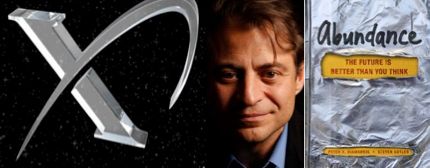 |
Aired 03/25/12
Recently the annual TED conference took place in Long Beach California. I have long recommended its famous 18 minute TED talks. Check out TED.com/talks, they cover a wide range of topics including science, technology, design, business, global issues and they have recurring themes of inspiration, challenge, and optimism. Not unlike what I try to do with this radio show.
On opening day the recent conference scheduled two talks one after the other. The first by Paul Gilding entitled The Earth is Full asked questions like Have we used up all our resources? Have we filled up all the livable space on Earth? Gilding suggests we have with the possibility of devastating consequences. In a talk that’s equal parts terrifying and oddly hopeful, he says “It takes a good crisis to get us going. When we feel fear and we fear loss we are capable of quite extraordinary things.”
That talk was followed by one by today’s guest, PETER DIAMANDIS, entitled Abundance Is Our Future in which he makes the case for optimism — that we’ll invent, innovate and create ways to solve the challenges that loom over us. “I’m not saying we don’t have our set of problems — problems – climate crisis, species extinction, water and energy shortage – we surely do. But ultimately, we knock them down.”
Since the dawn of humanity, a privileged few have lived in stark contrast to the majority. Conventional wisdom says this gap cannot be closed. But, according to a new book by Diamandis and co-author Steven Kotler, it is closing-fast. In Abundance: The Future is Better Than You Think, they document how progress in artificial intelligence, robotics, infinite computing, ubiquitous broadband networks, digital manufacturing, nanomaterials, synthetic biology, and many other exponentially growing technologies will enable us to make greater gains in the next two decades than we have in the previous two hundred years. They believe we will soon have the ability to meet and exceed the basic needs of every man, woman, and child on the planet.
http://www.abundancethebook.com


