Q&A w/ CHRISTOPHER RYAN, author (co-author, Cacilda Jethá) – SEX AT DAWN: How We Mate, Why We Stray, and What It Means for Modern Relationships
Written on June 4th, 2014 |
Aired: 04/28/13
In the best-selling book, SEX AT DAWN, CHRISTOPHER RYAN and co-author Cacilda Jethá aim to answer the question, “What is the essence of human sexuality and how did it get to be that way?” They contend that, “Cultural shifts that began about ten thousand years ago rendered the true story of human sexuality so subversive and threatening that for centuries it has been silenced by religious authorities, pathologized by physicians, studiously ignored by scientists, and covered up by moralizing therapists.”
What is that true story? According to Ryan and Jetha, first, “We didn’t descend from apes. We are apes.” They liken us most to bonobos. Further, “human beings evolved in intimate groups where almost everything was shared – food, shelter, protection, child care, even sexual pleasure.”
Needless to say, their attempt to overturn the accepted narrative on such a hot topic as sex has led to controversy. RYAN joins me this week to explore these questions.
Chris Ryan Podcast Link:
http://bit.ly/ZZqtKy
Free Forum Q&A – TIM DECHRISTOPHER: Civil disobedience (bidding) at public lands auction landed him 21 months in prison
Written on May 25th, 2014 |
Aired: 6/30/13
On December 19, 2008 TIM DeCHRISTOPHER disrupted a highly disputed BLM auction, effectively safeguarding thousands of acres of land. Not content to merely protest outside, Tim entered the auction hall and registered as bidder #70. He outbid industry giants on land parcels (which, starting at $2 an acre, were adjacent to national treasures like Canyonlands National Park), winning 22,000 acres of land worth $1.7 million Two months later, incoming Interior Secretary Ken Salazar invalidated the auction. Yet DeChristopher was indicted and tried on two federal felonies and spent 21 months in prison.
Released in April 2013, DeChristopher is the subject of documentary film, Bidder 70, which opened this weekend at the Music Hall in Beverly Hills and other theaters around the country. He joins me this week to tell his story. What led him to that auction? What went through his mind as he began bidding and winning? Why didn’t he take a plea deal? What was his experience in prison? What message does he have for others?
We’ll also talk about the state of the movements to deal with energy, environment, and climate change, in light of Obama’s recent speech and the eventual decision whether or not to build the KeystoneXL pipeline.
“At this point of unimaginable threats on the horizon, this is what hope looks like. In these times of a morally bankrupt government that has sold out its principles, this is what patriotism looks like. With countless lives on the line, this is what love looks like, and it will only grow…
— From Tim DeChristopher’s statement to the court at his sentencing hearing
Q&A: JONATHAN GOTTSCHALL, Author – THE STORYTELLING ANIMAL: How Stories Make Us Human
Written on May 23rd, 2014 |
Aired 12/02/12
Last July in an interview with Charlie Rose, President Obama said that “the mistake” of the early years of his presidency was his failure to be a better storyteller.
“The mistake of my first couple of years was thinking that this job was just about getting the policy right. And that’s important, but the nature of this office is also to tell a story to the American people that gives them a sense of unity and purpose and optimism, especially during tough times.” In a second term, he said, he would “spend more time with the American people, listening to them, but also being in a conversation with them about where do we go as a country?”
This week’s show is not about Obama or politics. It’s about story and narrative. My guest is JONATHAN GOTTSCHALL author of THE STORYTELLING ANIMAL.
The late evolutionary biologist Steven Jay Gould called humans “the primate who tells stories…” And it’s not just Gould. Anthropologists have found societies that have existed for millennia without the wheel, but they’ve never found one that doesn’t tell stories.
My website leads with a quote: “On the radio, I tell stories of a world that just might work. As a consultant, I help you tell yours.” Building on time as a teacher, two decades in the entertainment industry, and 15 years of radio interviews, I help non-profits, foundations, public agencies, and businesses to tell better stories and build better narratives.
I’m eager to learn from Jonathan what the latest science has to tell us. Why is narrative so powerful? What is its evolutionary value? And can what we’re learning help us get even better at tapping its power?
Q&A: CHARLES DUHIGG – THE POWER OF HABIT
Written on May 16th, 2014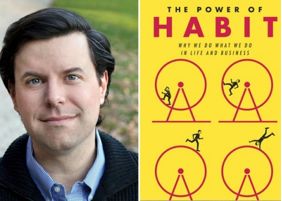 |
Aired 08/26/12
Humans are not alone in being creatures of habit, but can we do anything about it?
Brain science has learned a lot about habits over the last few years. On the one hand, that gives corporations new power with which to manipulate us, but it also gives us greater power over our own behavior.
What is a habit? Are habits positive – a sign of cultivation and industry, or negative, a sign of weakness and mindlessness? Or are they neutral, their value up to us?
Today’s guest, CHARLES DUHIGG an award-winning reporter for the New York Times, has written the best-selling THE POWER OF HABIT: Why We Do What We Do in Life and Business. He tells us that at its most basic level, a habit is a simple neurological loop: a cue (my mouth feels gross), a routine (I should brush my teeth), and a reward (ahhh, minty fresh!). Backing out of the driveway, replying to emails, running before work – many of our most basic daily actions are not, in fact, the products of well considered decision-making, but outgrowths of habits we often don’t even realize exist.
We’ll talk about what a habit is, how they are formed, and how we can put what we’ve learned about habits into practice, so that we are at least somewhat their masters rather than their slaves.
We will also discuss Duhigg’s investigative New York Times series on Apple, including their labor practices and why they don’t manufacture in the U.S.
Q&A: ANTONIO DAMASIO, M.D. Ph.D @ USC – Brain and Creativity Institute
Written on May 6th, 2014 |
Aired 01/09/11
ANTONIO DAMASIO, M.D. Ph.D is the David Dornsife Professor of Neuroscience and Director, Brain and Creativity Institute, at the University of Southern California. Damasio,the recipient of numerous honors worldwide and author of bestselling books, was elected to the American Academy of Arts & Sciences in 1999.
In his newest book, Self Comes to Mind, Antonio Damasio presents compelling new scientific evidence that consciousness-what we think of as a mind with a self-is a biological process created by a living organism. Damasio takes an evolutionary perspective and links the millions of single cells in the human body and brain with single celled organisms. Organisms use whatever tools they have to regulate and manage their biological systems, in order to maintain the balance or homeostasis essential to survive. As consciousness evolves to what he terms the autobiographical self in humans, life management aims not only for survival, but for well-being.
Damasio suggests that the brain’s development of a human self opens the way for the appearance of culture — a radical break in the course of evolution that offers a new level of life regulation – what he calls sociocultural homeostasis.
How are we doing? Is society — as an organism — managing itself to achieve balance? It doesn’t look good to me right now – in terms of equity, energy, consumption, climate change, etc.
http://www.usc.edu/schools/college/bci/


