
Disruptive: Cancer Vaccine & Hydrogel Drug Delivery
Written on December 5th, 2015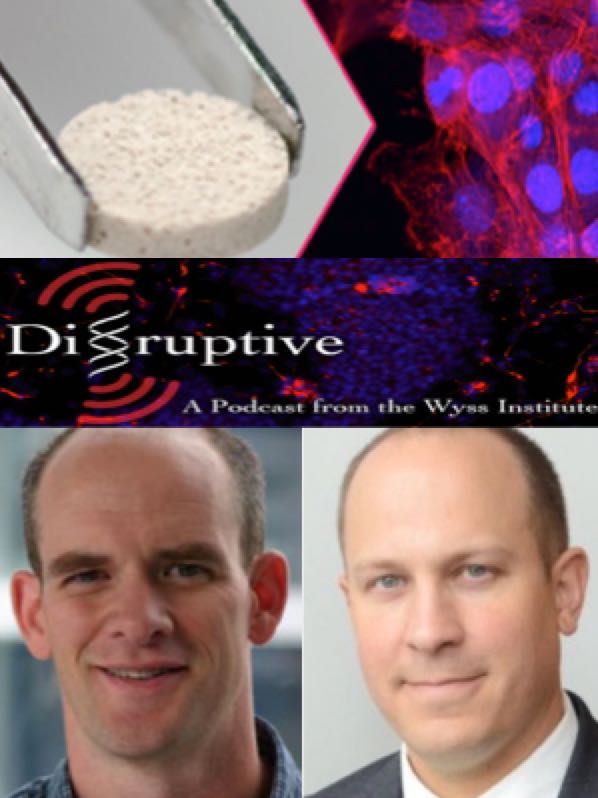
Welcome to DISRUPTIVE the podcast from Harvard’s Wyss Institute for Biologically Inspired Engineering.
In this episode of DISRUPTIVE, we will focus on a cancer vaccine and hydrogel drug depots – both being developed by Wyss Founding Core Faculty Member, DAVE MOONEY. Mooney says the human immune system is the most efficient weapon on the planet to fight disease. Cancer, however, resists treatment and cure by evading the immune system. Unlike bacterial cells or viruses, cancer cells belong in the body, but are simply mutated and misplaced. Scientists have been trying to develop vaccines that provoke the immune system to recognize cancer cells as foreign and attack them. The approach developed by Mooney’s group, in which they reprogram immune cells from inside the body using implantable biomaterials, appears simpler and more effective than other cancer vaccines currently in clinical trials. In one study, 50% of mice treated with two doses of the vaccine — mice that would have otherwise died from melanoma within about 25 days — showed complete tumor regression. On a second front, when it comes to delivering drugs or protein-based therapeutics, doctors often give patients pills or inject the drug into their bloodstream. Both are inefficient methods for delivering effective doses to targeted tissues. Mooney and his team at Wyss are taking a new approach using biocompatible and biodegradable hydrogels. They’ve developed a gel-based sponge that can be molded to any shape, loaded with drugs or stem cells, compressed to a fraction of its size, and delivered via injection. Once inside the body, it pops back to its original shape, gradually releases its payload, and safely degrades. After we explore both of these exciting projects with Mooney, we take a closer look at the process of translation of hydrogel technology into products and therapies with Chris Gemmiti, a business development lead at Wyss.
Free Forum Q&A – JACK KORNFIELD & TRUDY GOODMAN A CELEBRATION of MINDFULNESS
Written on October 31st, 2015
On November 15, InsightLA, the leading Los Angeles-based Mindfulness Meditation organization, will host LIVING WITH A JOYFUL SPIRIT AND A WISE HEART, a day of deep teachings and timeless wisdom that will feature Trudy Goodman and Jack Cornfield in dialogue via video with a “who’s who” of the pioneers of mindfulness meditation in the West – Jon Kabat-Zinn (Wherever You Go, There You Are), Ram Dass (Be Here Now), Tara Brach (Radical Acceptance), Joseph Goldstein (Insight Meditatino), and Congressman Tim Ryan (A Mindful Nation). Both Trudy and Jack turn 70 this year. In the course of the conversation, we talk about their personal paths, what each of their guests means to them, and we tell the story of mindfulness in America over the last forty-five years.
Trudy Goodman has trained and practiced in two fields for over 25 years: meditation and psychotherapy. She studied developmental psychology with Jean Piaget, Lawrence Kohlberg, and Carol Gilligan, and for 20 years worked in a full psychotherapy practice. Since 1974, Trudy has devoted much of her life to practicing Buddhist meditation and teaching mindfulness. In 2002, Trudy founded InsightLA.
Jack Kornfield is a co-founder of the Insight Meditation Society in Barre, Massachusetts, and founding teacher of the Spirit Rock Center in Woodacre, California. His books have been translated into 20 languages and sold more than a million copies. They include, A Path with Heart; After the Ecstasy, the Laundry; Buddha’s Little Instruction Book; and A Wise Heart: A Guide to the Universal Teachings of Buddhist Psychology.
DISRUPTIVE: BIO-INSPIRED ROBOTICS features three separate interviews with (1) RADHIKA NAGPAL, (2) ROBERT WOOD, and (3) CONOR WALSH
Written on October 15th, 2015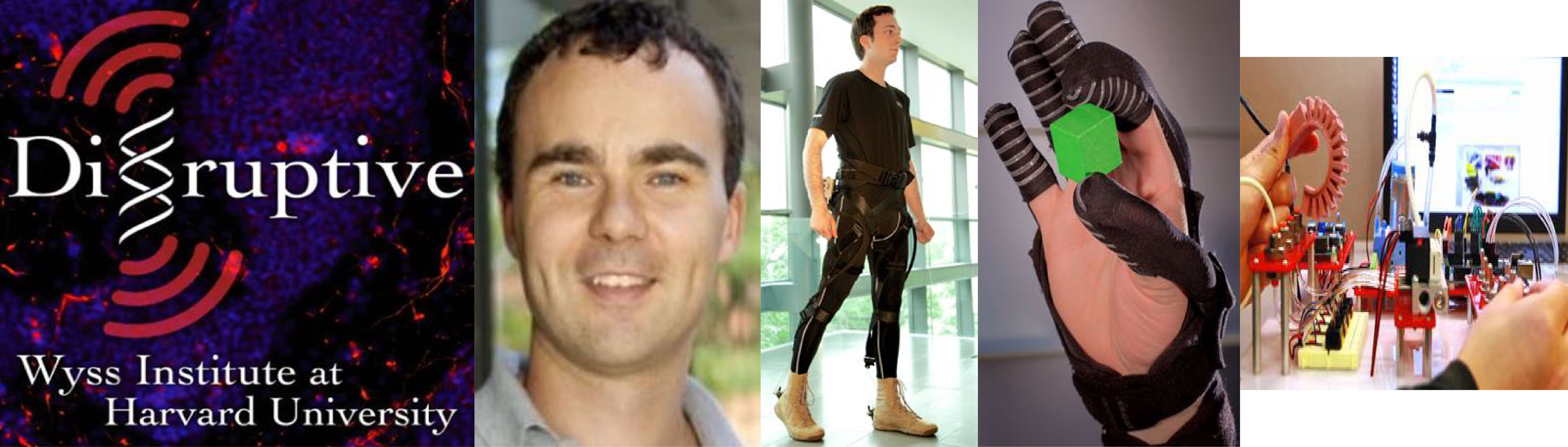
Welcome to the second episode of my new monthly podcast series produced with Harvard’s Wyss Institute for Biologically Inspired Engineering.
DISRUPTIVE: BIO-INSPIRED ROBOTICS features three separate interviews with (1) RADHIKA NAGPAL, (2) ROBERT WOOD, and (3) CONOR WALSH. From insects in your backyard, to creatures in the sea, to what you see in the mirror, engineers and scientists at Wyss are drawing inspiration to design a whole new class of smart robotic devices
In this one, CONOR WALSH discusses how a wearable robotic exosuit or soft robotic glove can assist people with mobility impairments, as well as how the goal to create real-world applications drives his research approach.
In part one, RADHIKA NAGPAL talks about her work Inspired by social insects and multicellular systems, including the TERMES robots for collective construction of 3D structures, and the KILOBOT thousand-robot swarm. She also speaks candidly about the challenges faced by women in the engineering and computer science fields.
In part two, ROBERT WOOD discusses new manufacturing techniques that are enabling popup and soft robots. His team’s ROBO-BEE is the first insect-sized winged robot to demonstrate controlled flight.
The mission of the Wyss Institute is to: Transform healthcare, industry, and the environment by emulating the way nature builds, with a focus on technology development and its translation into products and therapies that will have an impact on the world in which we live. Their work is disruptive not only in terms of science but also in how they stretch the usual boundaries of academia.
http://wyss.harvard.edu/
– See more at:
DISRUPTIVE: BIO-INSPIRED ROBOTICS Radhika Nagpal Interview
DISRUPTIVE: BIO-INSPIRED ROBOTICS Robert Wood Interview
Conor Walsh’s interview transcript
http://aworldthatjustmightwork.com/2015/07/auto-draft-18/
DISRUPTIVE: CONFRONTING SEPSIS – Don Ingber and Mike Super
Written on October 14th, 2015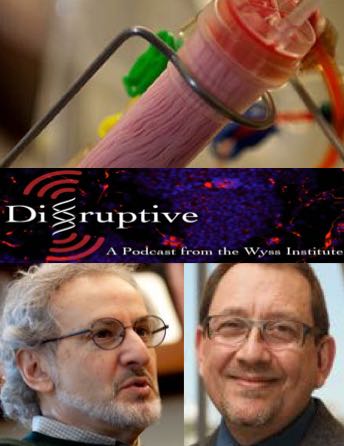
Welcome to DISRUPTIVE the podcast from Harvard’s Wyss Institute for Biologically Inspired Engineering.
In this episode of DISRUPTIVE, we will focus on: CONFRONTING SEPSIS.
Sepsis is a bloodstream infection in which the body’s organs become inflamed and susceptible to failure. The leading cause of hospital deaths, sepsis kills at least eight million people worldwide each year. It can be caused by 6 species of fungi and 1400 species of bacteria. Diagnosis takes two to five days, and every hour you wait can increase the risk of death by 5-9%.
“Even with the best current treatments, sepsis patients are dying in intensive care units at least 30% of the time,” says one of today’s guests, Wyss Senior Staff Scientist Mike Super.
A new device developed by a team at Wyss may radically transform the way we treat sepsis. Their blood-cleansing approach can be administered quickly, even without identifying the infectious agent. In animal studies, treatment with this device reduced the number of targeted pathogens and toxins circulating in the bloodstream by more than 99%.
The mission of the Wyss Institute is to: Transform healthcare, industry, and the environment by emulating the way nature builds, with a focus on technology development and its translation into products and therapies that will have an impact on the world in which we live. Their work is disruptive not only in terms of science but also in how they stretch the usual boundaries of academia.
Don Ingber and Mike Super’s Interview transcript
DISRUPTIVE: BIO-INSPIRED ROBOTICS features three separate interviews with (1) RADHIKA NAGPAL, (2) ROBERT WOOD, and (3) CONOR WALSH
Written on October 7th, 2015
Welcome to the second episode of my new monthly podcast series produced with Harvard’s Wyss Institute for Biologically Inspired Engineering.
DISRUPTIVE: BIO-INSPIRED ROBOTICS features three separate interviews with (1) RADHIKA NAGPAL, (2) ROBERT WOOD, and (3) CONOR WALSH. From insects in your backyard, to creatures in the sea, to what you see in the mirror, engineers and scientists at Wyss are drawing inspiration to design a whole new class of smart robotic devices
In this one, ROBERT WOOD discusses new manufacturing techniques that are enabling popup and soft robots. His team’s ROBO-BEE is the first insect-sized winged robot to demonstrate controlled flight.
In part one, RADHIKA NAGPAL talks about her work Inspired by social insects and multicellular systems, including the TERMES robots for collective construction of 3D structures, and the KILOBOT thousand-robot swarm. She also speaks candidly about the challenges faced by women in the engineering and computer science fields.
In part three, CONOR WALSH discusses how a wearable robotic exosuit or soft robotic glove could assist people with mobility impairments, as well as how the goal to create real-world applications drives his research approach.
The mission of the Wyss Institute is to: Transform healthcare, industry, and the environment by emulating the way nature builds, with a focus on technology development and its translation into products and therapies that will have an impact on the world in which we live. Their work is disruptive not only in terms of science but also in how they stretch the usual boundaries of academia.
http://wyss.harvard.edu/
– See more at:
DISRUPTIVE: BIO-INSPIRED ROBOTICS Radhika Nagpal Interview
DISRUPTIVE: BIO-INSPIRED ROBOTICS Conor Walsh Interview
Robert Wood’s interview transcript


