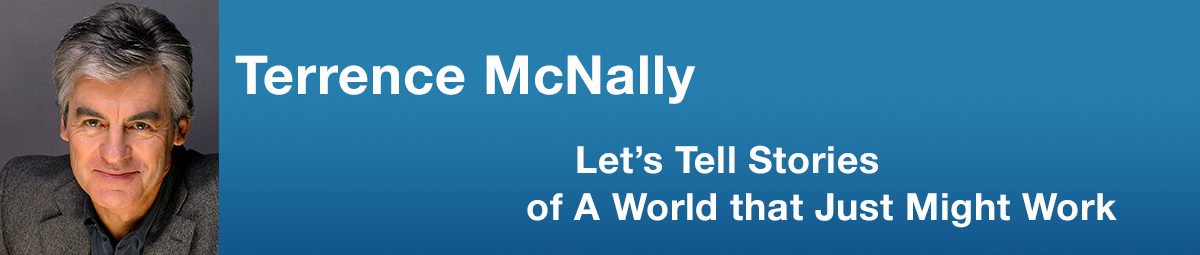
Free Forum Q&A – MARCIA COYLE Chief DC Correspondent, The National Law Journal Supreme Court Correspondent, PBS News Hour THE ROBERTS COURT: Struggle for the Constitution
Written on May 15th, 2015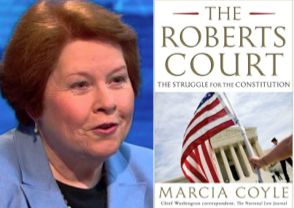
Originally aired July 2013
I struck up a conversation with a hip looking man in his late 20s-early 30s in a movie line on LA’s west side shortly before the 2004 election between George Bush and John Kerry. When asked who he planned to vote for, the young man answered that he hadn’t made up his mind. I said to him, “Two words. Supreme Court.” To which the young man replied, “Oh, are we voting for them too?”
While we may be disappointed in his apparent lack of civics knowledge, in his own way, he spoke the truth. The most lasting actions a president takes may be his appointments to the Supreme Court. Supreme Court justices serve for as long as they wish or as long as they are able. Their decisions very often set precedents that can live forever. Bush had appointed John Roberts Chief Justice in his first term, but according to today’s guest, it was his second term appointment of Samuel Alito to replace Sandra Day O’Connor that really solidified the Roberts Court.
O’Connor had been a much more moderate conservative than Alito has proven to be. The center of the court shifted to the right, which may matter little in decisions with large majorities – more than 50% of cases each term are decided unanimously or by 8-1 or 7-2 votes — but can be crucial in decisions decide 5-4.
MARCIA COYLE has chosen to focus her book THE ROBERTS COURT: The Struggle for the Constitution on four such 5-4 decisions – Citizens United on campaign finance; District of Columbia v Heller on gun control; on race in school choice; and on the constitutionality of the Affordable Care Act.
Free Forum Q&A – SYSTEMS THINKING (1) FRITJOF CAPRA, author of several books including The Tao of Physics; The Turning Point & (2) NORA BATESON, director AN ECOLOGY OF MIND doc re: her late father, Gregory Bateson
Written on May 7th, 2015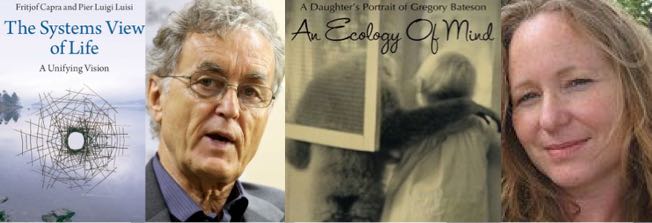
(1) FRITJOF CAPRA – Originally aired April 2009
(2) NORA BATESON – Originally aired July 2012
Both interviews this week explore systems thinking – one of the key ingredients of a world that just might work.
First. I speak with FRITJOF CAPRA, who wrote a book in 1981 that greatly influenced my view not only of science, medicine, agriculture, energy, and even politics – it influenced my view of reality. That book was THE TURNING POINT, and its message is as profound and revolutionary today. “We live today in a globally interconnected world, in which biological, psychological, social, and environmental phenomena are all interdependent. To describe this world appropriately we need an ecological perspective which the Cartesian world view does not offer. What we need, then, is a new ‘paradigm’ – a new vision of reality; a fundamental change in our thoughts, perceptions, and values.” Capra wrote those words in its preface.
In the second half my guest will be NORA BATESON, and we’ll talk about AN ECOLOGY OF MIND, the wonderful documentary she’s made about her father, the late anthropologist GREGORY BATESON. Her documentary is subtitled A Daughter’s Portrait of Gregory Bateson. It tells of the unique anthropologist, philosopher, author, naturalist, and systems theorist, who was ahead of his time in seeing reality as made up not of things or even of ideas, but of relationships. The film features interviews with California Governor Jerry Brown, physicist and systems theorist Fritjof Capra, Whole Earth Catalogue publisher Stewart Brand, cultural philosopher and poet William Irwin Thompson; and Nora’s sister, anthropologist Mary Catherine Bateson. Nora’s film will introduce Bateson to a new generation and remind many of us of the impact her father had on the way a lot of people perceived the world.
“The major problems in the world are the result of the difference between how nature works and the way people think.” Those are the words of the late Gregory Bateson – and I couldn’t agree more.
Free Forum Q&A – JOHN WARNER One of the founders of Green Chemistry Can we have progress without pollution?
Written on April 30th, 2015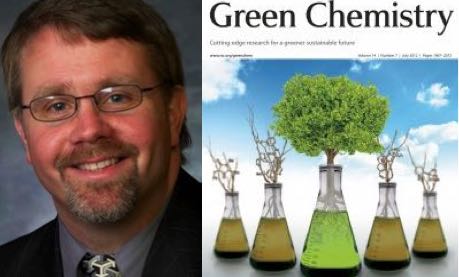
(Originally aired November 2010)
According to Scientific American, “Experts guesstimate that about 50,000 chemicals are used in U.S. consumer products and industrial processes. Why the uncertainty? The 1976 Toxic Substances Control Act does not require chemicals to be registered or proven safe before use. Because the Environmental Protection Agency must show, after the fact, that a substance is dangerous, it has managed to require testing of only about 300 substances that have been in circulation for decades. It has restricted applications of five.” The harmful side effects of chemicals have long been tolerated in the US as a price of progress and profits.
But in the early 1990s a small group of scientists began to think differently. Why, they asked, do we rely on hazardous substances for so many manufacturing processes? After all, chemical reactions happen continuously in nature, thousands of them within our own bodies, without any nasty by-products. Maybe, these scientists concluded, the problem was that chemists are not trained to think about the impacts of their inventions. Perhaps chemistry was toxic simply because no one had tried to make it otherwise. They called this new philosophy “green chemistry.”
J0HN WARNER and Paul Anastas are the founders of green chemistry and co-authors of Green Chemistry: Theory and Practice. In the book, they establish 12 guiding principles for chemists, concepts like preventing waste by incorporating as much of the materials used into the final product, and choosing the least complicated reaction. Warner left a lucrative job at Polaroid to found the nation’s first doctoral program in green chemistry. In 2007, to go beyond teaching, he founded Warner Babcock Institute for Green Chemistry, an innovation incubator, in Wilmington, Mass.
Green chemists use all the tools and training of traditional chemistry, but instead of ending up with toxins that must be treated and contained after the fact, they aim to create industrial processes that avert hazard problems altogether. The catch phrase is “benign by design”.
Free Forum Q&A – (1) BEN SKINNER, A CRIME SO MONSTROUS: Face to Face with Modern Day Slavery & (2) GABOR MATE M.D. IN THE REALM OF HUNGRY GHOSTS: Close Encounters With Addiction
Written on April 23rd, 2015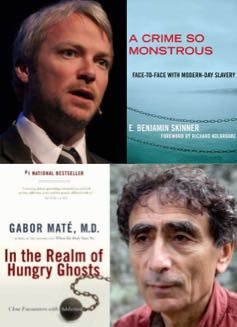
Ben Skinner(Originally aired April 2009)
Gabor Mate (Originally aired May 2011)
These interviews pursue a world that just might work. That pursuit, however, demands looking honestly at the darker aspects of human behavior, and this week’s interviews deal with slavery and addiction. In both cases, my guests draw on years of personal experience to frame their analyses and their proposed solutions.
To those who say society’s not actually making progress, many point to the fact that at least we’ve eliminated slavery. But sadly that is not the case. 143 years after passage of the 13th Amendment to the Constitution and 60 years after Article 4 of the U.N.’s Universal Declaration of Human Rights banned slavery worldwide, there are more slaves right now than at any time in human history – 27 million. The new slavery, which focuses on big profits and cheap lives, is not about owning people in the traditional sense of the old slavery, but about controlling them completely.
During the four years that BEN SKINNER researched modern-day slavery for his book, A CRIME SO MONSTROUS, he posed as a buyer at illegal brothels on several continents, interviewed convicted human traffickers in a Romanian prison and endured giardia, malaria, dengue and a bad motorcycle accident. But SKINNER says he’s most haunted by his experience in a brothel in Bucharest, Romania, where he was offered a young woman with Down syndrome in exchange for a used car.
Some might call addiction is a form of slavery. I am a long and consistent opponent of the war on drugs and of US policy toward illegal drugs and illegal drug users. I am also someone who advocates for a holistic view of reality, its challenges, and potential solutions. Holistic healing deals with the whole situation – mind, body, emotions, spirit and environment, treats root causes rather than symptoms, and treats as naturally and safely as possible. GABOR MATE, deals with the issues of drugs and addiction holistically. In the Realm of Hungry Ghosts proposes approaching addiction through an understanding of its biological and socio-economic roots.
http://acrimesomonstrous.com/
http://drgabormate.com/
Free Forum Q&A – TIM RYAN Congressman, author, A MINDFUL NATION: How a Simple Practice Can Help Us Reduce Stress, Improve Performance, Recapture American Spirit & WINIFRED GALLAGHER RAPT: Attention and the Focused Life
Written on April 2nd, 2015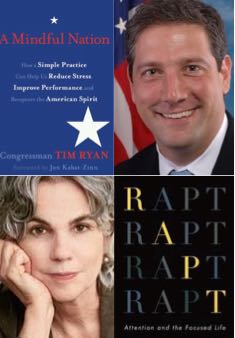
TIM RYAN (originally aired August 2012)
WINIFRED GALLAGHER (originally aired May 2009)
“My experience is what I agree to attend to.” — William James
This week we focus on mindful attention – hailed by ancient spiritual traditions and modern neuroscience alike as one of the keys to the quality of our lives.
In the first half, I’ll be joined by Ohio Congressman TIM RYAN, who offers a radical solution to the stresses and problems that face Americans today — radical in its original meaning of having to do with roots of things. He has written a book, A MINDFUL NATION: How a Simple Practice Can Help Us Reduce Stress, Improve Performance, and Recapture the American Spirit. Ryan has a daily practice of mindful meditation and now he’s advocating that the spread of similar practices could help heal us, not just as individuals but as a nation. And his book is filled with examples of how mindfulness is already being successfully applied in education, healthcare, even the military.
Then I’ll speak with bestselling author, WINIFRED GALLAGHER about her book, RAPT: Attention and the Focused Life. In it, she argues that “”The skillful management of attention is the… key to improving virtually every aspect of your experience, from mood to productivity to relationships.” Gallagher came to appreciate this while fighting a fairly advanced form of cancer. Determined not to let her illness “monopolize” her attention, she made a conscious choice to look “toward whatever seemed meaningful, productive, or energizing and away from the destructive, or dispiriting.” Her experience of the world was transformed, and she set out to learn more about the science of attention as well as what we can do to cultivate it.
Here’s one big tip based on neuroscience: GALLAGHER recommends starting your workday concentrating on your most important task for 90 minutes. At that point, your brain may need a break But don’t let yourself get distracted by anything else during that first hour and a half, because it can take the brain 20 minutes to reboot after an interruption.


