Q&A: NICHOLAS KRISTOF, NY Times Columnist and Author
Written on December 1st, 2009 |
Aired 11/22/09
NICHOLAS KRISTOF, oped columnist at the New York Times, and author with his wife, former Times editor Sheryl WuDunn, of HALF THE SKY: From Oppression to Opportunity for Women Worldwide."
Kristof grew up on a sheep and cherry farm near Yamhill, Oregon. He graduated Phi Beta Kappa from Harvard College and then studied law at Oxford University on a Rhodes Scholarship, graduating with first class honors. He joined the NY Times in 1984. In 1990 Mr. Kristof and his wife, Sheryl WuDunn, then also a Times journalist, won a Pulitzer Prize for their coverage of China's Tiananmen Square democracy movement. They were the first married couple to win a Pulitzer for journalism. Mr. Kristof won a second Pulitzer in 2006, for commentary for what the judges called "his graphic, deeply reported columns that, at personal risk, focused attention on genocide in Darfur and that gave voice to the voiceless in other parts of the world."
In his column, NICHOLAS KRISTOF was an early opponent of the Iraq war, and among the first to warn that we were losing ground to the Taliban in southern Afghanistan. He was among the first to raise doubts about WMD in Iraq, he was the first to report that President Bush's State of the Union claim about Iraq seeking uranium from Africa was contradicted by the administration's own investigation. His columns have often focused on global health, poverty and gender issues in the developing world. In particular, since 2004 he has written dozens of columns about Darfur and visited the area ten times.
Prior to their newest, HALF THE SKY, Mr. Kristof and Ms. WuDunn are authors of CHINA WAKES: THE STRUGGLE FOR THE SOUL OF A RISING POWER and THUNDER FROM THE EAST: PORTRAIT OF A RISING ASIA.
Q&A: PHILLIPE DIAZ – Writer and Documentary Director
Written on November 30th, 2009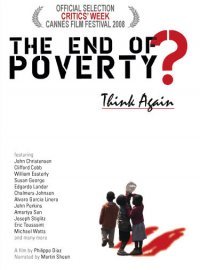 |
Aired 11/22/09
PHILLIPE DIAZ is writer director of a new documentary THE END OF POVERTY that exposes the roots of the south’s poverty first in colonialism and then in the policies of the World Bank, IMF and the WTO.
The film features: Nobel prize winners in economics Amartya Sen and Joseph Stiglitz; expert authors Susan George, Eric Toussaint, John Perkins, Chalmers Johnson, government ministers such as Bolivia’s Vice President Alvaro Garcia Linera, and leaders of social movements in Bolivia, Brazil, Venezuela, Kenya and Tanzania.
THE END OF POVERTY’s opening line by narrator Martin Sheen: “Why, in a world of so much wealth, do we still have so much poverty, where billions of people live on less than one dollar a day?” According to writer-director PHILLIPE DIAZ, the ultimate goal of the film is to change the dialogue around the poverty debate from "poverty is a shame," to "poverty exists for a reason."
Born in Paris France, PHILIPPE DIAZ studied Philosophy at the Sorbonne in Paris, and began his film career as a director in 1980. He produced a number of features both in France and the US, and in 2003, with a consortium of partners he created Cinema Libre Studio, to provide an alternative structure for intelligent, independent films. His directorial debut, THE EMPIRE IN AFRICA won the Grand Jury Award for Best Documentary Feature at Slamdance 2006.
According to Diaz, “The end of greed on Wall Street will not end poverty in the world. The problem is much deeper than that; it is centuries old. Our economic system since colonial times requires cheap labor and cheap resources from the global South to succeed and to finance our lifestyle in the North. Without changing that we will never alleviate poverty.“
Q&A: Malalai Joya, youngest member of Afghan Parliament and Author
Written on November 24th, 2009 |
Aired 11/15/09
Malalai Joya is an Afghan politician who has been called "the bravest woman in Afghanistan." As an elected member of the Wolesi Jirga from Farah province, she has publicly denounced the presence of what she considers warlords and war criminals in the parliament.
The daughter of a former medical student who lost a foot while fighting the Soviet invasion of Afghanistan, Malalai Joya was 4 years old when her family fled Afghanistan in 1982 to the refugee camps of Iran and later Pakistan. After the Soviet withdrawal, Malalai Joya returned to Afghanistan in 1998 during the Taliban's reign. As a young woman she worked as a social activist and was named a director of the non-governmental group, Organisation of Promoting Afghan Women's Capabilities (OPAWC) in the western provinces of Herat and Farah
Title of Joya's autobiography "Raising My Voice", which was published in the US/Canada under the title of "A Woman Among Warlords" was published in October 2009
Noam Chomsky writes: "Perhaps the most remarkable feature of this inspiring memoir is that despite the horrors she relates, Malalai Joya leaves us with hope that the tormented people of Afghanistan can take their fate into their own hands if they are released from the grip of foreign powers, and that they can reconstruct a decent society from the wreckage left by decades of intervention and the merciless rule of the Taliban and the warlords who the invaders have imposed upon them."
Q&A: Matthew HOH, former Marine Captain
Written on November 23rd, 2009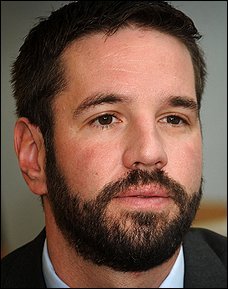 |
Aired 11/15/09
A former Marine captain with combat experience in Iraq, Matthew Hoh, also served in uniform at the Pentagon, and as a civilian in Iraq and at the State Department. This summer he was the senior US civilian in Zabul province, a Taliban hotbed. In September Hoh became the first US official known to resign in protest over the Afghan war.
His four page letter of resignation explains that he became convinced that our war in that country will not only inevitably fail, but is fueling the very insurgency we are trying to defeat.
He points out that "next fall, the United States' occupation will equal in length the Soviet Union's own physical involvement in Afghanistan."
"I have doubts and reservations about our current strategy and planned future strategy, but my resignation is based not upon how we are pursuing this war, but why and to what end."
The Pentagon’s own 2004 report concluded: "Negative attitudes and the conditions that create them are the underlying sources of threats to America's national security . . . Direct American intervention in the Muslim world has paradoxically elevated the stature of and support for Islamic radicals."
"American families," Hoh said at the end of his letter of resignaton, "must be reassured their dead have sacrificed for a purpose worthy of futures lost, love vanished, and promised dreams unkept. I have lost confidence such assurances can be made any more."
Q&A: STEWART BRAND, Author and Editor
Written on November 16th, 2009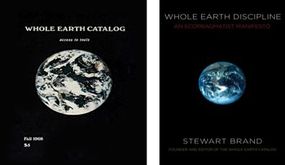 |
Aired 11/08/09
STEWART BRAND's Whole Earth Catalog introduced millions to new ways of thinking and doing and probably contributed to the birth of environmentalism in the US. Confronting today's challenges to global civilization in his new book, Brand questions environmental positions against GMO foods, Geo-engineering, and nuclear power.
In 1968 a totally original cultural item appeared. It owed something to old time catalogs perhaps akin to the Farmers almanac. Its style was funkily low-fi while its content had one foot in a simpler past and the other in a high tech sci-fi future. It was called the Whole Earth Catalog and subtitled "Access to Tools."
STEWART BRAND was its founder, editor and publisher, and Brand has been at the founding of several other cultural entities, events, and movements. Today, in his '70s, STEWART BRAND is no less curious, no less purposeful, and no less forward looking. His new book, WHOLE EARTH DISCIPLINE: An EcoPragmatist Manifesto, confronts the challenges we face as a global civilization - population, urbanization, resource depletion, peak oil, and most profoundly climate change, by issuing challenges of his own to what has passed for years as environmental orthodoxy. Brand characterizes many in a movement he helped to create and inspire as being anti-science, and anti-intellectual in their opposition to GMO foods, Geo-engineering, and nuclear power.
Forty years ago, Brand could say in the Whole Earth Catalog, "We are as gods, we might as well get good at it". Today in WHOLE EARTH DISCIPLINE, he says, "We are as gods and have to get good at it."
http://current.com/items/90416515_stewart-brand-proclaims-4-environmental-heresies.htm
http://web.me.com/stewartbrand/DISCIPLINE_footnotes/Recommended_Reading.html


