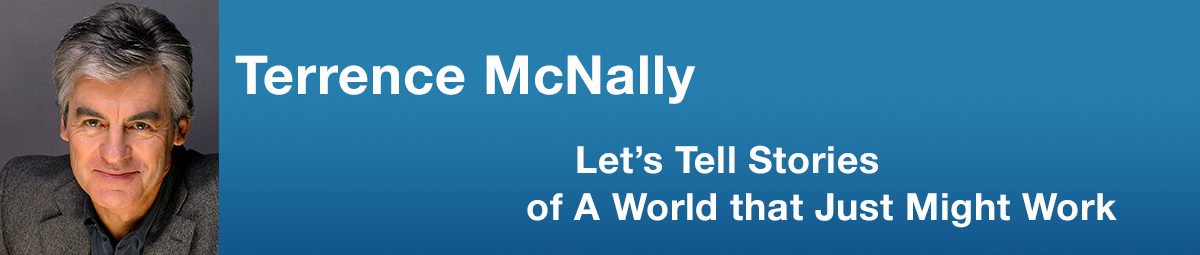
Free Forum with Terrence McNally

Sunday 1pm PT : KPFK 90.7fm Los Angeles CA, streaming at kpfk.org  
  Tuesday 10pm ET: WBAI 99.5fm New York NY, streaming at wbai.org

Terrence is also a fill-in host on KCRW’s NPR shows, To the Point and Left, Right, and Center

Scroll down for recent podcasts. Search for older ones by name of guest.

 ”Terrence McNally consistently goes for the long ball.”
 Robert Wright, The Moral Animal; The Politics of God

“…Grounds for hope, rays of light, and a damn fine hour of radio.”
 Daniel Goleman, Emotional Intelligence; Ecological Intelligence

On Free Forum we explore the lives, work and ideas of individuals I suspect hold pieces of the puzzle of a world that just might work. We look at new, innovative and provocative approaches to business, environment, health, science, politics, media, and culture. It’s all based on the fact that I believe we can do better and I want to find out how.

I engage the most visionary thinkers, writers, and doers I can find to make sense of the current moment and shed light on the path ahead. One week Michael Lewis explains the Wall Street crash, the next Father Greg Boyle and one of the thousands of gang members he’s hired at LA’s Homeboy Industries, offer hope. Other recent guests include Atul Gawande MD of The New Yorker, Temple Grandin, Nicholas Kristof of The New York Times, outspoken Afghanistan Parliament member Malalai Joya, Cornel West, Craig Venter, and Robert Wright.

Q&A – DANNY KENNEDY, ROOFTOP REVOLUTION: How Solar Power Can Save Our Economy and the Planet from Dirty Energy

DK-Roof  


Aired: 05/12/13

Is there a revolution coming to your rooftop? While opponents claim solar is expensive, inefficient, and unreliable, in his book ROOFTOP REVOLUTION: How Solar Power Can Save Our Economy And Our Planet From Dirty Energy, DANNY KENNEDY makes clear solar can save money, create jobs, and protect the environment if only politics and perception will get out of the way.

During the recent Presidential campaign, we heard a lot about Solyndra, the solar start-up that received a sizable government loan only to go belly up. Solar’s detractors claim the collapse of Solyndra proves solar is just a hippie pipe dream, but Danny Kennedy, says the truth is quite the opposite. Solyndra failed because it wasn’t able to compete in a red-hot industry, not because solar isn’t ready for prime time.

The industry employs 100,000 people in the United States, twice as many as in 2009 and twice the number of coal miners. In 2011, Warren Buffett invested $2 billion in a solar farm, and General Electric bought a start-up solar manufacturer, announcing, “By 2020 this is going to be at least a $1 billion product line.” Production of solar-generated electricity rose by 45% in the first three quarters of 2010, while electricity from natural gas rose only 1.6% and coal declined by 4.2%. Kennedy argues for a rooftop revolution to break the entrenched power of the coal, oil, nuclear, and natural gas industries and their progress-denying allies.

www.rooftoprevolutionbook.com

www.sungevity.com

Q&A w/ JEREMY SCAHILL (#5 NYTimes Best-seller) DIRTY WARS: The World is a Battlefield

JS-Dwars  


Aired: 05/05/13

In JEREMY SCAHILL’S new best-seller, DIRTY WARS, what begins as an investigation into a US night raid gone terribly wrong in a remote corner of Afghanistan quickly transforms into a high-stakes global investigation into the rise of Joint Special Operations Command, the most secret and elite fighting force in U.S. history. In military jargon, JSOC teams “find, fix and finish” their targets, who are selected through a secret process. No target is off limits for the “kill list,” including U.S. citizens.

It’s the unbounded, unending War on Terror: all bets are off, and almost anything goes. We have fundamentally changed the rules of the game and the rules of engagement. Today drone strikes, night raids, and U.S. government-condoned torture occur, generating unprecedented civilian casualties.

DIRTY WARS reveals covert operations unknown to the public and carried out across the globe by men who do not exist on paper and will never appear before Congress, raising questions about freedom and democracy, war and justice, morality and politics. No matter how little you know about these actions, they are being done in your name,

DIRTY WARS is also a documentary which opens in theaters June 7th.

Q&A w/ CHRISTOPHER RYAN, author (co-author, Cacilda Jethá) – SEX AT DAWN: How We Mate, Why We Stray, and What It Means for Modern Relationships

Sex-Cr-CJ.1  

 Aired: 04/28/13

In the best-selling book, SEX AT DAWN, CHRISTOPHER RYAN and co-author Cacilda Jethá aim to answer the question, “What is the essence of human sexuality and how did it get to be that way?” They contend that, “Cultural shifts that began about ten thousand years ago rendered the true story of human sexuality so subversive and threatening that for centuries it has been silenced by religious authorities, pathologized by physicians, studiously ignored by scientists, and covered up by moralizing therapists.”

What is that true story? According to Ryan and Jetha, first, “We didn’t descend from apes. We are apes.” They liken us most to bonobos. Further, “human beings evolved in intimate groups where almost everything was shared – food, shelter, protection, child care, even sexual pleasure.”

Needless to say, their attempt to overturn the accepted narrative on such a hot topic as sex has led to controversy. RYAN joins me this week to explore these questions.

www.chrisryanphd.com

www.sexatdawn.com

Chris Ryan Podcast Link:

http://bit.ly/ZZqtKy


Q&A: HENRY JENKINS, SPREADABLE MEDIA – Creating Value and Meaning in a Networked Culture

spreadable-HJ  

Aired: 04/21/13

“If it doesn’t spread, it’s dead,” is the simple consistent message of a new book, SPREADABLE MEDIA: Creating Value and Meaning in a Networked Culture, that maps the changes taking place in our media environment. For all their consolidation, concentration, and money, corporations can no longer control media distribution. Millions are now directly involved in the creation and circulation of content.

“Stickiness” – focusing attention in centralized places — has been the measure of success in the broadcast era. No more. “Spreadability” – dispersing content through formal and informal networks, with and without permission – is the new goal.

What does this mean for media? For information? For culture? For the distribution of power? And how can you take advantage of the new realities to have greater impact and influence?

I’ll be talking about all of that this week with one of the book’s authors, HENRY JENKINS. He coined the term “participatory culture” and he’s been paying attention for decades to the crowd on the other side of the camera, the microphone, and the screen.

www.henryjenkins.org

www.spreadablemedia.org